A distribution agreement is a legal commercial contract under which a supplier or manufacturer of goods agrees that an independent third party namely a distributor, sells such goods. The distributor, also referred to as a reseller, buys the goods on own account and trades under their own name by re-selling the goods to his customer.
Key elements typically included in a distribution agreement include but are not limited to:
Parties involved
Territory
Product details
Area exclusivity
Term
Obligations and responsibilities
Pricing and payment terms
Termination clauses
Intellectual property
Confidentiality clauses
Dispute resolution
Governing law
A practical example is the following: Malta One Electronics Business is the manufacturer of smartphones, and they have entered into an exclusive distribution agreement with Malta Two Distribution Business to market and sell their smartphones in Malta. The drawn agreement will outline the terms, responsibilities, and rights of both parties, and it serves to protect the interests of both the manufacturer and the distributor in the distribution and reselling of smartphones.
It’s also important to distinguish between a distribution agreement and a franchise contract. These are not the same; they are distinct legal agreements with different purposes and characteristics. The key difference between a distribution agreement and a franchise contract lies in the degree of control, the creation of a separate business entity, and the use of an established brand. While both types of agreements involve the distribution of products or services, they serve different purposes and have distinct legal and operational implications. A distribution agreement typically focuses on the distribution of products, while a franchise contract involves a more comprehensive partnership, including the use of an established brand and business model.
Distribution agreements can vary significantly depending on the industry, the territory, the specific products involved, and ultimately on the negotiation between the parties. It’s essential for both parties to carefully review and understand the terms of the agreement to avoid any unnecessary misunderstandings and legal battles, and ultimately one should seek legal advice to ensure that their interests are adequately protected. At Sciberras Advocates, as part of our contract law services, we address our client’s requirements, safeguarding their interests. We take pride on the fact that we can draft, review and negotiate any type of contract and agreements in all areas of practice.
هذا المقال لأغراض إعلامية فقط ولا ينبغي اعتباره استشارة قانونية.
بقلم: السيدة شارلين سكيبرس، بكالوريوس (مع مرتبة الشرف)، كاتبة ضيفة، وهي متخصصة في التسويق وإدارة الأعمال مع تركيز خاص على الشؤون المؤسسية والمحاسبية والقانونية.
تُعد «Sciberras Advocates»، التي أسسها الدكتور أدريان سكيبيراس، شركة محاماة مقرها مالطا. وتفخر الشركة بطابعها متعدد التخصصات وابتكارها ومرونتها، مما يتيح لها مواكبة التطورات المستمرة والتصدي لأي تحديات في المشهد القانوني المحلي والدولي. بغض النظر عن مدى تعقيد المتطلبات الخاصة أو المؤسسية، تقدم «Sciberras Advocates» حلولاً قانونية عملية وفعالة من حيث التكلفة لتحقيق النتائج التي ترغبون فيها. يمكنكم التواصل مع «Sciberras Advocates» عبر الهاتف على الرقم +35627795222أو عبر البريد الإلكتروني على [email protected].
The maritime industry in Malta is a major economic driver. Malta’s strategic location in the Mediterranean Sea, its well-developed infrastructure, and its competitive costs have made it a popular choice for maritime businesses around the world. The maritime industry in Malta also plays a leading role in the development of new technologies and services and the Maltese government is committed to supporting the maritime industry and promoting its growth by focusing on innovation and sustainability in alignment with the trends in the global maritime industry.
The maritime industry in Malta is diverse, encompassing a wide range of activities, including ship registration. Malta has one of the largest ship registries in the world, making it to the top 10 flag states by registered tonnage. Its high standards have earned it a reputation as a ‘white flag state’. This means that the Maltese flag is not considered a flag of convenience, and it is trusted by foreign investors in the Maltese shipping industry.
There are several advantages to registering a ship in Malta such as flexibility, cost-effectiveness, and reputation in the authority that regulates this sector. Additionally, the country’s tax system provides significant fiscal benefits to operators and ship managers. Ships of all types and sizes can be registered in Malta, including commercial vessels, yachts, and private vessels.
To register a ship in Malta, in principle the owner must submit a set of documents to the Malta Ship Registry through Transport Malta, at the Maritime section, namely a bill of sale, a survey certificate, ownership documentation and payment of registration fees. Once the registration process is complete, the ship will be issued a Maltese flag certificate and a registration number.
The maritime industry in Malta is a dynamic and growing sector that is playing an important role in the country’s economy, and it is expected to continue to grow in Malta in the coming years.
The experts at Sciberras Advocates are well-equipped to guide clients through the ship and yacht registration process. Whether you are a ship owner or manager, we can help you leverage the cost-effective registration fees and service charges available in Malta, resulting in substantial cost savings for you and your company.
هذا المقال لأغراض إعلامية فقط ولا ينبغي اعتباره استشارة قانونية.
بقلم: السيدة شارلين سكيبرس، بكالوريوس (مع مرتبة الشرف)، كاتبة ضيفة، وهي متخصصة في التسويق وإدارة الأعمال مع تركيز خاص على الشؤون المؤسسية والمحاسبية والقانونية.
تُعد «Sciberras Advocates»، التي أسسها الدكتور أدريان سكيبيراس، شركة محاماة مقرها مالطا. وتفخر الشركة بطابعها متعدد التخصصات وابتكارها ومرونتها، مما يتيح لها مواكبة التطورات المستمرة والتصدي لأي تحديات في المشهد القانوني المحلي والدولي. بغض النظر عن مدى تعقيد المتطلبات الخاصة أو المؤسسية، تقدم «Sciberras Advocates» حلولاً قانونية عملية وفعالة من حيث التكلفة لتحقيق النتائج التي ترغبون فيها. يمكنكم التواصل مع «Sciberras Advocates» عبر الهاتف على الرقم +35627795222أو عبر البريد الإلكتروني على [email protected].
SMEs and family businesses are the backbone of the Maltese economy. This was one of the opening liners from the speeches given to attendees at the Transeo Winter Summit Malta 2023, held on the 12وث and 13وث of October with the collaboration of the Family Business Office in Malta.
Throughout history, family businesses have played a pivotal role in shaping Malta’s economic landscape, often standing as resilient and dynamic pillars of its economy. Despite many successful family businesses, these enterprises are often vulnerable due to various factors such as the lack of succession planning, interest diversification from one generation to the other, personal conflicts between family members, management transitions, balancing family dynamics with business decision, and more, which in the long run bring challenges to what we associate as a strong business with clear visions and values.
Strategic planning, governance, succession planning, business transfers, business sale, fresh ownership, mergers and acquisitions are all topics that were discussed during the summit to which our associate lawyers Dr Roseanne Sant Cortis and Dr Daniil Kazakov attended.
Family businesses are an integral part of the Maltese economy and have a significant presence in the country. These businesses often span various sectors, including retail, manufacturing, tourism, and services, providing employment opportunities, and fostering economic growth. Many family businesses in Malta have a long history, with some dating back several generations. These businesses have successfully passed down their legacy, knowledge, and values from one generation to the next but like family businesses everywhere, Maltese family enterprises face challenges. The Family Business Office in Malta provides support for family businesses through various initiatives, including financial assistance, training programs, and incentives to promote growth and innovation.
Very often family businesses are complex and carry certain wealth in terms of the business itself and property investments, which often require legal advice when it comes to succession, inheritance, estate and wealth planning, business take over or exit strategies. Should you wish to consult with one of our lawyers do not hesitate to contact us: [email protected].
هذا المقال لأغراض إعلامية فقط ولا ينبغي اعتباره استشارة قانونية.
بقلم: السيدة شارلين سكيبرس، بكالوريوس (مع مرتبة الشرف)، كاتبة ضيفة، وهي متخصصة في التسويق وإدارة الأعمال مع تركيز خاص على الشؤون المؤسسية والمحاسبية والقانونية.
تُعد «Sciberras Advocates»، التي أسسها الدكتور أدريان سكيبيراس، شركة محاماة مقرها مالطا. وتفخر الشركة بطابعها متعدد التخصصات وابتكارها ومرونتها، مما يتيح لها مواكبة التطورات المستمرة والتصدي لأي تحديات في المشهد القانوني المحلي والدولي. بغض النظر عن مدى تعقيد المتطلبات الخاصة أو المؤسسية، تقدم «Sciberras Advocates» حلولاً قانونية عملية وفعالة من حيث التكلفة لتحقيق النتائج التي ترغبون فيها. يمكنكم التواصل مع «Sciberras Advocates» عبر الهاتف على الرقم +35627795222أو عبر البريد الإلكتروني على [email protected].
The action of spoliation, referred legally as the Actio Spolii, is a possessory action intended to protect possession. As confirmed in the judgement of June Jackson vs Leonard Jackson, decided on the 22nd of January 1990, the action of spoliation is concerned more with the exigencies of social utility and public order. One prominent writer on spoliation is Pacifici Mazzoni, who had argued that spoliation is ultimately an arbitrary act of a person, against of the wishes of the person who is so dispossessed.
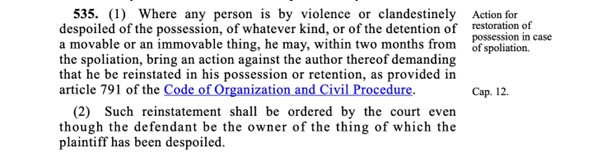
The Actio Spolii has at the forefront of its agenda the restoration of possession, and it aims to avert the taking of the law into one’s own hands. This action is regulated in our Civil Code, specifically Article 535 of Chapter 16 of the Laws of Malta:
From this article of the law, three cumulative requisites emanate; firstly, there is the material element of the action where there must be the possession of a thing, which can even be momentarily. Such possession can be of both immovables and movables, provided that it is corporeal, and hence, has a physical existence. Although possession of the property may be acquired in good or bad faith, the mere use of the property will not subsist for an action of spoliation. This action also extends itself to detention, that is, one holding in the name of another, such as a lessee, and a usufructuary, amongst others. Nonetheless, as confirmed in the judgement of Farrugia vs Cassar, decided in 1933, this action cannot be instituted if detention of the property is based only on mere tolerance.
Secondly, for this action to persist there must be the act of spoliation itself. In Maltese diction, this spoliation is referred to as ‘jitnezza mill-pusses’. For a successful action of spoliation, it must happen either through violence or clandestinely. These two terms were defined by the Court in the case of Cesareo vs Trapani, decided in 1950; the taking of possession is regarded to be violent when, either through moral or material means, the will of the possessor was vitiated. Conversely, spoliation is done clandestinely, when it is done without the awareness of the possessor or holder of the property. Notably, here, the molestation or threatening of spoliation does not suffice, but the deprivation of enjoyment of the property must actually take place. Moreover, as repeatedly held by the courts, the Animus Spolianti is not a requirement, i.e., the intentional element is irrelevant.
Interestingly, when it comes to spoliation, the Latin maxim Vim Vi Repellere Licet is applicable, whereby it is justified to repel force by force. Therefore, ultimately, if the aggressor is trying to materially take possession of the property by force, rather than by violence or by clandestinity, then, it is lawful to repel that same force with corresponding force.
Lastly, the Actio Spolii must be instituted within two months from when possession was lost. Here, we find conflicting judgements as to whether this two-month period starts to run from when the spoliation took place, or else from when the plaintiff became aware of such spoliation. For instance, in Azzopardi vs Azzopardi, decided in 1982, the Court declared that this period starts to run from when the spoliation begins, whilst in Alfred Paul Farrugia noe vs Peter Paul Cutajar, decided on the 13وث of February 2004, the Court held that this starts to run from when the possessor becomes aware that his property is being molested. However, the prevailing view is the former; the two-month period of forfeiture starts to run from when the action of spoliation begins, rather than a die sciece.
Occasionally, the action of spoliation is very apparent and evident. Indeed, often the action of spoliation transpires in separation proceedings, in conjunction to the matrimonial home. This occurs when although, legally, both parties have a right to reside in the property, failing a court decree pendente lite, one of the spouses takes full possession of the property, prohibiting the other spouse from entering. On the other hand, more complex matters would include those involving servitudes, leading to the deprivation of privacy. One case in point, decided this year, is Joseph Farrugia et vs Carmelo sive Charlie Spiteri, decided on the 30وث of May 2023, by the First Hall Civil Court. The plaintiffs had a right of way over the property of the defendants, which was eventually closed by the latter with the use of a chain and padlocks. Possession over the land was proved successfully by the plaintiffs through a temporary emphyteusis payable by their son to the defendants. Accordingly, the Court requested that all padlocks be removed, since by the closure of the right of way, spoliation was indeed taking place.
When it comes to the action of spoliation, reference should also be made to Article 791 of the Code of Organisation and Civil Procedure, Chapter 12 of the Laws of Malta, dealing with pleas in spoliation suits. In terms of this article, prior to examining any other petitory pleas, the Court will limit its enquiry to the question of possession and spoliation, and will not consider any other factor, until there is the restoration of the property. Therefore, the defendant can only bring forward dilatory pleas, and hence, evidence of title on the part of the defendant is not applicable in this action. This is all encompassed in the Latin maxim Spoliatus Ante Omnia Restituendus, which translates to when there is spoliation, before anything else is considered, there should be the restitution of possession.
Concludingly, put simply, spoliation is the wrongful use of property belonging to another third party. The outcome of this action would be the restoration of possession to its former condition. This would be even the case if the person who had committed the spoliation holds ownership over the property. This is since this possessory action is one of social order and juridical stability; every transfer of possession should be done through legal means, rather than through an arbitrary act of a person.
هذا المقال لأغراض إعلامية فقط ولا ينبغي اعتباره استشارة قانونية.
Article and research done by Ms Caitlin Turner, currently reading a Bachelor of Laws (Honours) at University of Malta.
تُعد «Sciberras Advocates»، التي أسسها الدكتور أدريان سكيبيراس، شركة محاماة مقرها مالطا. وتفخر الشركة بطابعها متعدد التخصصات وابتكارها ومرونتها، مما يتيح لها مواكبة التطورات المستمرة والتصدي لأي تحديات في المشهد القانوني المحلي والدولي. بغض النظر عن مدى تعقيد المتطلبات الخاصة أو المؤسسية، تقدم «Sciberras Advocates» حلولاً قانونية عملية وفعالة من حيث التكلفة لتحقيق النتائج التي ترغبون فيها. يمكنكم التواصل مع «Sciberras Advocates» عبر الهاتف على الرقم +35627795222أو عبر البريد الإلكتروني على [email protected].
If you have an overstay ban in a country, it means that you have violated the terms of your visa or immigration status and have been subjected to a penalty that prevents you from entering or remaining in that country for a specified period. There are many different scenarios for an overstay in Malta, such as a visa overstay, being terminated from your employment and not applying for a new job within 10 days of termination, and other scenarios. In any such a situation, seeking the assistance of a immigration lawyer can be beneficial in many ways.
There are a lot of consequences for overstaying in the Schengen Area and it’s good to know that an overstay never goes unnoticed and whether the overstay is international or not, it is always punished by either a fine, immediate deportation and getting banned from re-entering the Schengen Zone for a specific amount of time.
If you overstay in the Schengen Area, you risk:
Deportation
Difficulties coming back to Schengen Area
Fines
Ban from Schengen Area
If you are in an overstay status, or you have received a return order to go back to your country or received a ban at the airport by the immigration police, you have the right to regularise your position and appeal this decision. Engaging the expertise of an immigration lawyer is essential for many reasons. A lawyer can evaluate your case and immigration history to understand the reasons for the overstay and the specific terms of the ban. A lawyer can explain your rights and options under immigration law and can guide you through the process, ensuring that all necessary documentation is submitted correctly and on time.
Sciberras Advocates offers professional support for various immigration matters, including appeals at the Immigration Appeals Board, preparing written requests to the Principal Immigration Officer for appeals, regularisation of status, challenging removal orders, and overturning bans. If you require expert legal assistance for immigration-related matters, we invite you to visit our dedicated webpage on immigration services in Malta: https://sciberras.legal/practice-areas/immigration-law/. Alternatively, you can contact us to consult with one of our experienced immigration lawyers. We are committed to providing effective solutions tailored to your specific immigration needs.
هذا المقال لأغراض إعلامية فقط ولا ينبغي اعتباره استشارة قانونية.
بقلم: السيدة شارلين سكيبرس، بكالوريوس (مع مرتبة الشرف)، كاتبة ضيفة، وهي متخصصة في التسويق وإدارة الأعمال مع تركيز خاص على الشؤون المؤسسية والمحاسبية والقانونية.
تُعد «Sciberras Advocates»، التي أسسها الدكتور أدريان سكيبيراس، شركة محاماة مقرها مالطا. وتفخر الشركة بطابعها متعدد التخصصات وابتكارها ومرونتها، مما يتيح لها مواكبة التطورات المستمرة والتصدي لأي تحديات في المشهد القانوني المحلي والدولي. بغض النظر عن مدى تعقيد المتطلبات الخاصة أو المؤسسية، تقدم «Sciberras Advocates» حلولاً قانونية عملية وفعالة من حيث التكلفة لتحقيق النتائج التي ترغبون فيها. يمكنكم التواصل مع «Sciberras Advocates» عبر الهاتف على الرقم +35627795222أو عبر البريد الإلكتروني على [email protected].
Sciberras Advocates and Belgravia Advisory have recently won an appeal on behalf of a Colombian who requested legal representation on a personal case. This case was against Identity Malta Agency (IMA). A Colombian national applied for a Single Permit as a still abroad in March 2022, indicating to IMA that he was not in Malta. Once processed, the approval in principle was issued in May 2022 with an appointment for biometrics set for June 2022. During the biometrics meeting, it was established that the applicant has entered and remained in Malta since January 2022 and therefore was overstay.
With Dr Adrian Sciberras from Sciberras Advocates, and Dr Karl Cordina, both representing the client, an appeal was filed with the Immigration Appeals Board (IAB). Together we filed various submissions to the case. Following evidence produced, the IAB accepted the appellant’s appeals and directed IMA to process and decide upon the work permit application without considering the Third Country National to have been illegally present.
Sciberras Advocates offers professional support for various immigration matters, including appeals at the Immigration Appeals Board, preparing written requests to the Principal Immigration Officer for appeals, challenging removal orders, and overturning bans. If you require expert legal assistance for immigration-related issues, we invite you to visit our dedicated webpage on immigration services in Malta: https://sciberras.legal/practice-areas/immigration-law/. Alternatively, you can directly contact us to consult with one of our experienced immigration lawyers. We are committed to providing effective solutions tailored to your specific immigration needs.
هذا المقال لأغراض إعلامية فقط ولا ينبغي اعتباره استشارة قانونية.
بقلم: السيدة شارلين سكيبرس، بكالوريوس (مع مرتبة الشرف)، كاتبة ضيفة، وهي متخصصة في التسويق وإدارة الأعمال مع تركيز خاص على الشؤون المؤسسية والمحاسبية والقانونية.
تُعد «Sciberras Advocates»، التي أسسها الدكتور أدريان سكيبيراس، شركة محاماة مقرها مالطا. وتفخر الشركة بطابعها متعدد التخصصات وابتكارها ومرونتها، مما يتيح لها مواكبة التطورات المستمرة والتصدي لأي تحديات في المشهد القانوني المحلي والدولي. بغض النظر عن مدى تعقيد المتطلبات الخاصة أو المؤسسية، تقدم «Sciberras Advocates» حلولاً قانونية عملية وفعالة من حيث التكلفة لتحقيق النتائج التي ترغبون فيها. يمكنكم التواصل مع «Sciberras Advocates» عبر الهاتف على الرقم +35627795222أو عبر البريد الإلكتروني على [email protected].
A new setup has emerged for employees and workers in Malta with the establishment of the Employee Support Rights Malta (ESRM) group. Dedicated to upholding the rights and interests of workers across Malta and Gozo, ESRM is committed to providing guidance, assistance, and representation throughout the process of seeking recourse for workplace issues.
In an era where job security and fair treatment are of paramount importance, ESRM has positioned itself as a vital resource for the workforce in Malta. The primary mission of the group is to empower employees by guiding them through the often complex and challenging process of seeking justice and fair compensation.
At the heart of ESRM’s mission is a commitment to assist employees in submitting claims to the Department of Industrial and Employment Relations (DIER). The group recognises that navigating the legal framework can be daunting, and ESRM’s legal experts are here to simplify the process, ensuring that every worker’s voice is heard, and rights are protected. ESRM goes beyond mere assistance with paperwork. The group is prepared to represent employees before the Industrial Tribunal, ensuring they have a strong advocate by their side during this critical phase.
Moreover, ESRM is committed to facilitating potential out-of-court settlements through effective negotiation. ESRM recognises that not every case needs to go to trial, and the group’s skilled negotiators will work tirelessly to achieve fair and equitable resolutions for all parties involved.
ESRM welcomes all employees and workers in Malta to reach out for guidance and support. Whether facing workplace discrimination, unfair dismissal, or any other employment-related issue, ESRM is here to champion your cause. Employee Support Rights Malta is administered by Sciberras Advocates. You can follow the page here: https://www.facebook.com/EmployeeSupportRightsMalta.
هذا المقال لأغراض إعلامية فقط ولا ينبغي اعتباره استشارة قانونية.
بقلم: السيدة شارلين سكيبرس، بكالوريوس (مع مرتبة الشرف)، كاتبة ضيفة، وهي متخصصة في التسويق وإدارة الأعمال مع تركيز خاص على الشؤون المؤسسية والمحاسبية والقانونية.
تُعد «Sciberras Advocates»، التي أسسها الدكتور أدريان سكيبيراس، شركة محاماة مقرها مالطا. وتفخر الشركة بطابعها متعدد التخصصات وابتكارها ومرونتها، مما يتيح لها مواكبة التطورات المستمرة والتصدي لأي تحديات في المشهد القانوني المحلي والدولي. بغض النظر عن مدى تعقيد المتطلبات الخاصة أو المؤسسية، تقدم «Sciberras Advocates» حلولاً قانونية عملية وفعالة من حيث التكلفة لتحقيق النتائج التي ترغبون فيها. يمكنكم التواصل مع «Sciberras Advocates» عبر الهاتف على الرقم +35627795222أو عبر البريد الإلكتروني على [email protected].
Our client, a local company, had employed an individual on a full-time employment contract, for an indefinite period. The employee was dismissed from employment for negligent behaviour at work. Furthermore, the employee at that time had failed to inform our client, the employer, regarding her pregnancy, even though she had claimed that she was willing to return to employment on a full-time basis post maternity leave.
Employment problem
During the employment, the employee did not conduct herself properly and eventually, following a meeting held at the company’s premises, the directors notified the employee that they were no longer willing to employ her. The employee refused to resign, and eventually she was served with a letter from Jobsplus regarding her termination from her place of work for disciplinary reasons. The applicant felt highly aggrieved by this decision, attesting that she always performed her work diligently. Accordingly, she filed an action in front of the Industrial Tribunal, and raised the argument that her termination was solely a consequence of her pregnancy and referred to both Article 36(14) of the Employment and Industrial Relations Act (Chapter 452 of the Laws of Malta) and Subsidiary Legislation 452.9, ‘Protection of Maternity (Employment) Regulations’. This, even though our client was never made aware of her pregnancy.
The Tribunal did not uphold the applicant’s claim, and voted in favour of our client by asserting that the termination from employment was a result of her behaviour at work, and that her pregnancy was an external factor to such dismissal. The Tribunal based its conclusion on corroborating evidence from other employees and ex-employees of the company, who all alleged that the applicant was negligent in her duties and placed a burden on the other team members to conduct the tasks that were primarily assigned to her. Moreover, reference was made to other employees who, after their maternity leave had elapsed, returned to work on a full-time basis.
From cross examining one of the employees of the company, who had a managerial role, it was concluded that although no written attestation of wrongful behaviour was issued to the applicant, there were various verbal warnings on such regard. Consequently, the Industrial Tribunal pronounced that the termination of the applicant was based on just grounds and was not unlawful.
An appeal
The Tribunal’s decision was eventually appealed by the employee who through her lawyer reinforced the arguments and stated that although the witnesses had declared that the employee’s attitude at the place of work was not ideal, there was no concrete evidence to showcase this.
Sciberras Advocates argued that the appeal is null and void since an appeal from a Tribunal’s decision can only be on points of law and can never be on a point of fact.
خاتمة
Concluding, what the court had to decide is whether the appeal was done on a point of law or on a point of fact, basing itself on article 82(3) of the Employment and Industrial Relations Act. Moreover, the point of law being elucidated upon must have already been determined by the Tribunal itself. The Court upheld the Tribunal’s decision and argued that the appeal is not regarding on a point of law, but rather a fresh evaluation of the evidence produced. The court, ultimately, was not convinced with the way the aggravations were put forward, and accordingly, decided in our client’s favour.
هذا المقال لأغراض إعلامية فقط ولا ينبغي اعتباره استشارة قانونية.
Article written by Ms Caitlin Turner, currently reading a Bachelor of Laws (Honours) at University of Malta.
تُعد «Sciberras Advocates»، التي أسسها الدكتور أدريان سكيبيراس، شركة محاماة مقرها مالطا. وتفخر الشركة بطابعها متعدد التخصصات وابتكارها ومرونتها، مما يتيح لها مواكبة التطورات المستمرة والتصدي لأي تحديات في المشهد القانوني المحلي والدولي. بغض النظر عن مدى تعقيد المتطلبات الخاصة أو المؤسسية، تقدم «Sciberras Advocates» حلولاً قانونية عملية وفعالة من حيث التكلفة لتحقيق النتائج التي ترغبون فيها. يمكنكم التواصل مع «Sciberras Advocates» عبر الهاتف على الرقم +35627795222أو عبر البريد الإلكتروني على [email protected].
When a business is sold, the fate of the employees can vary depending on the circumstances of the sale and the new owner’s intentions. Here are some general common scenarios that may occur when a business is sold:
Business as usual with new owner: In some cases, the new owner intends to continue operating the business with minimal changes. In such a scenario, the existing employees may retain their positions, and their employment terms and conditions may remain unchanged. The new owner may evaluate the employees’ performance and retain those who are essential to the business’s operations.
Layoffs: If the new owner acquires the business to restructure or streamline operations, they might decide to downsize the workforce. This could lead to layoffs of some employees, especially if certain roles or departments are duplicated or no longer necessary in the new owner’s vision for the business.
Transfer of employment: In some acquisitions, the new owner might decide to transfer a certain number of employees to the new entity while offering them comparable roles and benefits. This is more common in mergers where two businesses combine to create a new entity.
Re-evaluation and hiring process: In some cases, the new owner may conduct a thorough evaluation of the existing workforce and then decide to rehire some employees based on their skills, qualifications, and fit for the new company’s culture and goals. This might involve the affected employees having to go through a hiring process again.
Contractual obligations: The fate of the employees could also be influenced by employment contracts or union agreements. If there are clauses in the contracts that protect employees in the event of a sale, the new owner may have to adhere to those terms and retain the employees for a certain period or under specific conditions.
Severance packages and benefits: In situations where employees are laid off or their positions are made redundant due to the sale, the original company or the new owner might offer severance packages or provide certain benefits to support the employees during the transition.
Business closure: In some unfortunate instances, the new owner may acquire the business with the intention of shutting it down. This would lead to the termination of all employees’ contracts, and they may be offered severance packages or other benefits, depending on the local labour laws and contractual obligations.
It’s important to note that local laws and regulations related to employee rights and protections will play a significant role in determining how employees are treated during a business sale. Under Maltese law, the transfer of a business or part of a business to a new owner is governed by the Transfer of Business (Protection of Employment) Regulations (S.L. 452.85). The Protection of Employment Law applies at EU level in order to facilitate cross-border transactions between companies and ensuring, at the same time, that the right to employment is not violated.
In Malta, the law provides strong protections for employees in connection with the sale of a business. The Transfer of Business (Protection of Employment) Regulations aim to safeguard the rights and interests of employees in cases of business transfers, ensuring continuity of employment and protecting against unfair treatment.
When a business is sold, the employees cannot be dismissed solely as a result of the sale. If such dismissals occur, they are considered unfair dismissals under Maltese law. This means that an employer cannot terminate an employee’s contract just because the business has been sold, as the transfer of business itself does not constitute a valid reason for termination.
In the case of a transfer of business, the employment contracts of the affected employees are automatically transferred to the new employer. The transfer should be done with the same terms and conditions of employment as before the transfer took place. This means that employees’ rights, benefits, and working conditions should remain unchanged due to the transfer of business. The new employer is obliged to respect and honour the existing employment contracts, and any changes made without the employees’ consent would be in violation of the law.
The purpose of these protections is to safeguard employees’ rights and job security during a business sale. It ensures that employees do not suffer unjust consequences due to a change in ownership, and that their employment remains stable despite the transfer of the business to a new owner.
It’s essential for both the selling and acquiring businesses to comply with these regulations to avoid potential legal issues and disputes with employees. If any disputes arise, employees have the right to pursue legal action for unfair dismissal or any breach of their employment rights in connection with the business sale.
As with any legal matters, it’s crucial to consult with a qualified employment lawyer in Malta to ensure full compliance with the country’s labour laws and regulations when handling business transfers and employee-related issues. Sciberras Advocates holds exceptional expertise in employment and labour law matters, including aspects such as the sale of businesses and its impact on employees’ future, cases of unfair dismissal, employment discrimination, workplace harassment, redundancy situations, employees’ rights for claims, and an array of other related issues. For assistance in employment and labour law, visit our practice area page: https://sciberras.legal/practice-areas/employment-labour-law/.
هذا المقال لأغراض إعلامية فقط ولا ينبغي اعتباره استشارة قانونية.
بقلم: السيدة شارلين سكيبرس، بكالوريوس (مع مرتبة الشرف)، كاتبة ضيفة، وهي متخصصة في التسويق وإدارة الأعمال مع تركيز خاص على الشؤون المؤسسية والمحاسبية والقانونية.
تُعد «Sciberras Advocates»، التي أسسها الدكتور أدريان سكيبيراس، شركة محاماة مقرها مالطا. وتفخر الشركة بطابعها متعدد التخصصات وابتكارها ومرونتها، مما يتيح لها مواكبة التطورات المستمرة والتصدي لأي تحديات في المشهد القانوني المحلي والدولي. بغض النظر عن مدى تعقيد المتطلبات الخاصة أو المؤسسية، تقدم «Sciberras Advocates» حلولاً قانونية عملية وفعالة من حيث التكلفة لتحقيق النتائج التي ترغبون فيها. يمكنكم التواصل مع «Sciberras Advocates» عبر الهاتف على الرقم +35627795222أو عبر البريد الإلكتروني على [email protected].
Our client, a Third Country National from Nepal, arrived in Malta on the 3rd of July 2022 after being issued with a residence permit allowing him to work with a local company. His residence permit was valid from the 22nd of July 2022 until the 22nd of July 2023. On the 26وث of August 2022, our client decided to travel to Porto on holiday and had a return flight ticket back to Malta on the 3rd of September 2022.
Airport drama
When at the airport, our client was stopped at the gate, his employer was contacted to verify whether he was aware of client’s trip to Porto. The employer could not be reached but the Inspector spoke to a company representative, and it resulted that the representative was not aware whether appellant took days off to travel. At this stage our client was issued with a removal order, return decision and entry ban valid for the period of 3 years.
Lawyers’ intervention
At that point the client contacted Dr Adrian Sciberras from Sciberras Advocates and Dr Karl Cordina from Belgravia Advisory to assist with an appeal at the Immigration Appeals Board.
Day of sitting: Appellant vs Principal Immigration Officer
During the sitting, the Principal Immigration Officer stated the facts of the story and presented a copy of flight itinerary to the Immigration Appeals Board (IAB), which flight tickets were purchased on the 24وث of August 2022, prior to our client’s departure out of Malta. From all the evidence produced, it resulted that the appellant’s arrival in Malta was on the 3rd of July 2022, weeks before the trip to Porto. Our client was already in possession of a valid single permit and his flight itinerary was showing an outbound flight to Porto on the 26وث of August 2022 and an inbound flight to Malta on the 5وث of September 2022, which flights were purchased prior to the issuance of the return decision and removal order, issued on the 26وث of August 2022. We presented other arguments, evidence, and documents to support the appellant.
Decision by the Immigration Appeals Board
The IAB found that on the day the appellant was stopped at the gate, the appellant was not contravening any of the grounds upon which the return decision, removal order and entry ban were issued. In view of the above, the IAB upheld the appellants appeal and revoked the return decision, removal order and entry ban issued on the 26وث of August 2022.
Need assistance?
Sciberras Advocates can assist in appeals at the Immigration Appeals Board or written requests to Principal Immigration Officer to appeal, overturn bans and challenge removal orders. More information about immigration services can be found here: https://sciberras.legal/practice-areas/immigration-law/ or contact us directly to speak to one of our immigration lawyers.
هذا المقال لأغراض إعلامية فقط ولا ينبغي اعتباره استشارة قانونية.
بقلم: السيدة شارلين سكيبرس، بكالوريوس (مع مرتبة الشرف)، كاتبة ضيفة، وهي متخصصة في التسويق وإدارة الأعمال مع تركيز خاص على الشؤون المؤسسية والمحاسبية والقانونية.
تُعد «Sciberras Advocates»، التي أسسها الدكتور أدريان سكيبيراس، شركة محاماة مقرها مالطا. وتفخر الشركة بطابعها متعدد التخصصات وابتكارها ومرونتها، مما يتيح لها مواكبة التطورات المستمرة والتصدي لأي تحديات في المشهد القانوني المحلي والدولي. بغض النظر عن مدى تعقيد المتطلبات الخاصة أو المؤسسية، تقدم «Sciberras Advocates» حلولاً قانونية عملية وفعالة من حيث التكلفة لتحقيق النتائج التي ترغبون فيها. يمكنكم التواصل مع «Sciberras Advocates» عبر الهاتف على الرقم +35627795222أو عبر البريد الإلكتروني على [email protected].
نستخدم ملفات تعريف الارتباط على موقعنا الإلكتروني لتزويدك بتجربة أكثر ملاءمة من خلال تذكر تفضيلاتك وزياراتك المتكررة. بالنقر على “قبول”، فإنك توافق على استخدام جميع ملفات تعريف الارتباط.
يستخدم هذا الموقع ملفات تعريف الارتباط لتحسين تجربتك أثناء تصفحك للموقع. من بين هذه الملفات، يتم تخزين ملفات تعريف الارتباط المصنفة على أنها ضرورية في متصفحك لأنها ضرورية لعمل الوظائف الأساسية للموقع. نستخدم أيضًا ملفات تعريف الارتباط الخاصة بالأطراف الثالثة التي تساعدنا في تحليل وفهم كيفية استخدامك لهذا الموقع. سيتم تخزين ملفات تعريف الارتباط هذه في متصفحك فقط بموافقتك. لديك أيضًا خيار إلغاء الاشتراك في ملفات تعريف الارتباط هذه. لكن إلغاء الاشتراك في بعض ملفات تعريف الارتباط هذه قد يؤثر على تجربة التصفح الخاصة بك.
ملفات تعريف الارتباط الضرورية ضرورية للغاية لكي يعمل الموقع بشكل صحيح. تضمن هذه الملفات تعريفات الارتباط الوظائف الأساسية والميزات الأمنية للموقع، بشكل مجهول.
ملف تعريف الارتباط
مدة
الوصف
ملف تعريف الارتباط-كتلة-تحليلات
11 شهر
يتم تعيين هذه الكعكة بواسطة إضافة موافقة ملفات تعريف الارتباط الخاصة باللائحة العامة لحماية البيانات. يستخدم ملف تعريف الارتباط لتخزين موافقة المستخدم على ملفات تعريف الارتباط في فئة "التحليلات".
cookielawinfo-checkbox-functional
11 شهر
يتم تعيين ملف تعريف الارتباط بواسطة موافقة ملف تعريف الارتباط للائحة العامة لحماية البيانات لتسجيل موافقة المستخدم على ملفات تعريف الارتباط في فئة "وظيفي".
cookielawinfo-checkbox-others
11 شهر
يتم تعيين هذا الكوكي بواسطة إضافة GDPR Cookie Consent. يتم استخدام الكوكي لتخزين موافقة المستخدم على ملفات تعريف الارتباط في فئة "أخرى".
مربع اختيار ضروري لـ CookieLawInfo
11 شهر
يتم تعيين هذا الكوكي بواسطة إضافة موافقة ملفات تعريف الارتباط GDPR. يتم استخدام الكوكي لتخزين موافقة المستخدم على ملفات تعريف الارتباط في فئة "ضروري".
كوكيلاوإنفو-تشيكبوكس-برفورمانس
11 شهر
يتم تعيين هذا الكوكي بواسطة مكون GDPR Cookie Consent الإضافي. يتم استخدام الكوكي لتخزين موافقة المستخدم على ملفات تعريف الارتباط في فئة "الأداء".
تمت مشاهدة سياسة ملفات تعريف الارتباط
11 شهر
يتم تعيين ملف تعريف الارتباط بواسطة مكون GDPR Cookie Consent الإضافي ويستخدم لتخزين ما إذا كان المستخدم قد وافق على استخدام ملفات تعريف الارتباط أم لا. لا يخزن أي بيانات شخصية.
تُستخدم ملفات تعريف الارتباط التحليلية لفهم كيفية تفاعل الزوار مع الموقع. تساعد هذه الملفات في تقديم معلومات حول المقاييس مثل عدد الزوار، ومعدل الارتداد، ومصدر الزيارات، وما إلى ذلك.
تُستخدم ملفات تعريف الارتباط الإعلانية لتزويد الزوار بإعلانات وحملات تسويقية ذات صلة. تتتبع ملفات تعريف الارتباط هذه الزوار عبر مواقع الويب وتجمع المعلومات لتقديم إعلانات مخصصة.