
La politique de migration de la main-d'œuvre de Malte vise à retenir les travailleurs qualifiés de pays tiers.

Sciberras Advocates

Cet article a été initialement publié ici : https://businessnow.mt/lawyer-says-new-malta-labour-migration-policy-aims-to-retain-skilled-tcn-workers-while-promoting-fairness/.

Des modifications dans la politique de migration de la main-d'œuvre commencent à être mises en œuvre en août et en octobre..

Les changements à venir dans la politique maltaise de migration de main-d'œuvre sont sur le point d'apporter un changement significatif dans la façon dont les ressortissants de pays tiers (RPT) vivent et travaillent à Malte, les experts juridiques notant l'intention double d'encourager la rétention et d'améliorer l'équité pour tous.

L'un des changements notables est l'ajustement des frais de demande et de renouvellement. À partir du 1er août 2025, le coût pour les demandeurs novices passera de 300 € à 600 €, tandis que les frais de renouvellement seront réduits à 150 €. Commentant cette réforme, le Dr Adrian Sciberras, fondateur de Sciberras Advocates, déclare à BusinessNow.mt que ces modifications de frais sont susceptibles d'influencer les comportements.

“ Oui, nous pensons que l'augmentation des frais de dossier de 300 € à 600 € est susceptible de décourager certaines nouvelles candidatures, du moins à court terme ”, dit-il. “ Parallèlement, la réduction des frais de renouvellement à 150 € constitue une incitation tangible pour les ressortissants de pays tiers déjà présents à Malte à y rester et à renouveler leur statut. ”

Le Dr Sciberras a expliqué que cette mesure pourrait bénéficier aux travailleurs déjà bien intégrés dans le pays et cherchant à faire progresser leur carrière. “ Dans l'ensemble, cet ajustement favorise la rétention plutôt que les nouveaux arrivants, et nous nous attendons à ce qu'il ait un impact réel sur les prises de décision ”, ajoute-t-il.

Un autre changement majeur bien accueilli par les spécialistes de l'immigration est la prolongation du délai de grâce pour les travailleurs TCN licenciés. Actuellement limitée à 10 jours, cette période sera désormais prolongée à 30 jours, avec la possibilité d'une prolongation supplémentaire de 30 jours si l'individu peut démontrer son autosuffisance financière.

“ Forts de notre expérience en tant que cabinet de droit de l'immigration, nous avons travaillé avec de nombreux clients qui étaient extrêmement préoccupés par la limite actuelle de 10 jours. Concrètement, il est souvent très difficile, voire impossible, pour une personne de trouver un nouvel emploi et de préparer une demande complète dans un délai aussi court ”, explique le Dr Sciberras. “ Le passage à 30 jours, et potentiellement 60 jours, est donc une évolution très bienvenue. Cela offre plus de temps, de stabilité et d'équité dans le processus. ”

Cette flexibilité accrue devrait améliorer l'expérience de recrutement pour les travailleurs comme pour les employeurs.

“ Ce changement est assez significatif ”, ajoute-t-il. “ Il donne aux demandeurs d'emploi TCN ainsi qu'aux employeurs maltais un délai plus raisonnable pour passer par un processus de recrutement approprié, examiner les CV, mener des entretiens, négocier les conditions d'emploi et soumettre une nouvelle demande de permis unique, sans pression indue. ”

La réforme pourrait également encourager une plus grande mobilité parmi les travailleurs TCN, en particulier ceux qui se trouvent dans des situations d'emploi insatisfaisantes. Cependant, cette flexibilité accrue a ses propres limites.

“ La période de grâce prolongée pourrait certainement donner aux TCN la confiance nécessaire pour envisager de changer d'emploi s'ils se trouvent dans des situations insatisfaisantes ”, explique le Dr Sciberras. “ Cependant, il est à noter que les nouveaux frais de 600 € s'appliquent également à un changement d'employeur. Ce coût pourrait décourager les changements d'emploi fréquents, en particulier pour les travailleurs à faible revenu. Bien que la réforme favorise la flexibilité, les considérations financières pourraient encore limiter la mobilité en pratique. ”

Les entreprises seront également confrontées à de nouvelles obligations dans le cadre de la politique réformée, notamment une obligation de publier des offres d'emploi pendant trois semaines avant d'embaucher de nouveaux ressortissants de pays tiers. Si certains employeurs peuvent y voir un obstacle à un recrutement rapide, le Dr Sciberras estime que cela améliorera la qualité du recrutement.

“ Bien que cela puisse sembler retarder le processus d'embauche, nous pensons qu'une période de publicité de trois semaines est raisonnable et justifiée ”, a-t-il déclaré. “ Embaucher le bon employé, qu'il soit maltais, national de l'UE ou ressortissant d'un pays tiers, est une décision commerciale critique. ”

Cette exigence, note-t-il, s'aligne sur les pratiques déjà courantes dans des secteurs tels que le tourisme et l'hôtellerie, où les besoins en personnel sont planifiés bien à l'avance. Elle fait également écho à des obligations similaires de test du marché du travail que l'on trouve dans d'autres États membres de l'UE.

“ Oui, de nombreux États membres de l'UE ont historiquement imposé des exigences de test du marché du travail, obligeant les offres d'emploi à être publiées pendant une période déterminée avant que les employeurs ne puissent embaucher des ressortissants de pays tiers ”, confirme-t-il.

Au-delà de ces réformes phares, le Dr Sciberras souligne quelques autres développements clés qui pourraient remodeler le paysage pour les employeurs comme pour les employés. Il s'agit notamment des seuils de salaire révisés pour l'Initiative pour les employés clés (KEI) et l'Initiative pour les employés spécialisés (SEI), désormais fixés respectivement à 45 000 € et 30 000 €, ainsi que des procédures de vérification plus strictes pour le renouvellement des permis.

“ Ces réformes reflètent un engagement fort du gouvernement et d’Identità à protéger à la fois les employeurs et les employés et à gérer le marché du travail local de manière plus durable et transparente ”, a-t-il déclaré.

La politique sur les migrations de main-d'œuvre, lancée pour consultation publique en janvier 2025 et dont la mise en œuvre débutera en août et octobre, vise à équilibrer les besoins économiques de Malte avec la responsabilité sociale. Comme l'a résumé le Dr Sciberras, ces réformes ne sont pas de simples ajustements administratifs, mais elles représentent une vision plus stratégique et à long terme de la gestion de la main-d'œuvre à Malte.

Cet article est à titre informatif seulement et ne doit pas être interprété comme un avis juridique.

Article écrit parMme Nicole Zammit.

Sciberras Advocates, fondé par Dr Adrian Sciberras, est un cabinet d'avocats basé à Malte. Le cabinet s'enorgueillit d'être multidisciplinaire, innovant et flexible afin de répondre aux évolutions et aux défis du paysage juridique local et international. Quelle que soit la complexité des demandes privées ou d'entreprise, Sciberras Advocates propose des solutions juridiques pratiques et rentables pour atteindre les résultats souhaités. Vous pouvez contacter Sciberras Advocates par téléphone au +35627795222ou par courriel sur [email protected].

The new Malta Permanent Residency Programme

Lawyer Malta

Malta launches the Malta Permanent Residency Programme.

Residency Malta Agency has recently revamped the Malta Permanent Residency Programme (MPRP), making it a faster, permanent and transparent EU residency while retaining a strong compliance and regulatory framework.

The new 2025 programme stands out due to various new introductions and features such as a temporary residence permit issued at the art of the application process. Upon approvals, this temporary permit is then changed to a permanent one.

The qualifying investment sum remains unchanged, however there will be newly updated fees starting from January 2025. Other changes include details in the qualifying property and licensing framework which will move formally to Residency Malta Agency.

These changes aim to offer greater flexibility for investors and their families, making the Malta Permanent Residency Programme a strong and attractive residency option.

Licensed agent under Authorised Registered Mandatories number ARM04222.

Cet article est à titre informatif seulement et ne doit pas être interprété comme un avis juridique.

Article rédigé par Mme Charlene Sciberras, B.A. (Hons), rédactrice invitée, est une spécialiste du marketing et de la gestion d'entreprise avec un accent particulier sur les questions d'entreprise, comptables et juridiques.

Sciberras Advocates, fondé par Dr Adrian Sciberras, est un cabinet d'avocats basé à Malte. Le cabinet s'enorgueillit d'être multidisciplinaire, innovant et flexible afin de répondre aux évolutions et aux défis du paysage juridique local et international. Quelle que soit la complexité des demandes privées ou d'entreprise, Sciberras Advocates propose des solutions juridiques pratiques et rentables pour atteindre les résultats souhaités. Vous pouvez contacter Sciberras Advocates par téléphone au +35627795222ou par courriel sur [email protected].

Malta Labour Migration Policy Implementation

Malta Immigration Policy

In reference to the implementation of the Malta Labour Migration Policy throughout 2025, a total of 15 measures will commence implementation, while an additional 5 will be introduced on a continuous basis. Of the 15 scheduled measures, 12 are set to begin in August, with the remaining 3 rolling out in October.

Measures commencing in August 2025:

  1. Monitoring of Minimum Termination Rates Prior to Application:
    Monitoring of termination rate thresholds will begin in August. Jobsplus will alert applicants if thresholds are surpassed. No penalties will be enforced at this stage, as a phased approach will be taken to align the market with acceptable rates. As of October 2025, the threshold will be set at 15 percentage points above the target and will decrease by 5 percentage points every three months until July 2026.
  1. Vacancy Requirement:
    Starting August 2025, applicants must provide proof that vacancies were advertised for two to three weeks on appropriate media channels. As of October 2025, advertisements on the Jobsplus/EURES portal will be compulsory.
  1. Redundancies:
    Full implementation will begin on 1 August 2025.  If an employer has made any worker redundant (regardless of nationality, including Maltese nationals) due to business closure or lack of work for the same job position during the previous 12 months, the application will be rejected.
  1. Timely Submission of Engagement and Termination Forms:
    From 1 August 2025, employers who fail to comply will receive notifications. Regularisation will occur gradually.
  1. Compliance with the Persons with Disability (Employment) Act (CAP 210):
    Employers found to be in breach will be informed immediately, and full compliance will be required by 1 August 2025. Sanctions will follow non-compliance. Applications for TCN workers will be suspended until the end of the month in which the employer achieves compliance.
  1. Updated Fee Structures:
    Revised fees will take effect from 1 August 2025. The work permit fees will be structured as follows:
    • First-time applications: €600
    • Renewal fee: €150 per year for the duration of the permit
    • Change of employer: €600
    • Change of designation: €300
    • For occupations in the health sector and roles involving elderly and disability care, all fees will be set at €150.
    • Any other fees currently below this threshold will remain unchanged.
  1. Extended Grace Period for TCNs After Employment Termination:
    This will be fully implemented on 1 August 2025. The new flexible approach will be granting TCNs a 30-day period following employment termination, during which these TCNs may legally remain in Malta to seek new employment. Furthermore, it includes a provision to extend this initial 30-day period by an additional 30 days, bringing the total potential stay to 60 days, contingent upon the TCN demonstrating sufficient financial resources to support themselves without accessing social assistance.
  1. New Salary Benchmarks for KEI and SEI:
    The updated benchmarks will be introduced on 1 August 2025. The revised salary thresholds for the KEI and SEI are the following:
    • KEI: an annual gross salary of at least €45,000 per annum
    • SEI: an annual gross salary of at least €30,000 per annum
  1. Restrictions on Single Permit Applications for Non-Work Visa Holders:
    Enforcement will begin on 1 August 2025. Applications from TCNs present in Malta on visas not allowing work (e.g. tourist visas) will be rejected. The engagement of sportspersons is exempted from this restriction. Identita’ shall have discretion to exempt applications, only in exceptional and genuine cases.
  1. Verification of Renewal Applications:
    These checks will commence from 1 August 2025. Renewals will be contingent upon verification that the working conditions, as stipulated in the work contract at the time of single permit application approval, are being maintained. Jobsplus and Identita’ will request confirmation – including through information collected from tax authorities – that the working conditions are being met.
  1. Workforce Application Quotas:
    Limits will come into force on 1 August 2025. Employers are eligible to apply for additional TCNs based on a fixed percentage of their workforce.
  1. Support Measures for Partners and Families:
    These will be introduced starting 1 August 2025. The following categories of individuals will be issued a residence permit that explicitly includes a notation exempting them from the standard single permit process typically required for TCNs:
    • partners of Maltese nationals
    • parents of Maltese nationals who are under 23 years old.

In such cases, an employment licence would still be required but this would be similar to that granted to beneficiaries of protection (on their own name, not restricted to an employer).

Measures commencing in October 2025:

  1. Salary Payment Method for Newly Engaged TCNs

As of 1 October 2025, all salary payments to third-country nationals whose employment have been registered from 1 August 2025 onwards, must be conducted exclusively via licensed financial institutions (electronic payments). Cash payments will no longer be recognised as fulfilling the requirements of the employment contract.

  1. Interim Permits for TCNs from Visa Waiver Countries

TCNs that originate from visa waiver countries and apply for a single permit within 60 days of entering the Schengen Area will be granted an interim permit allowing them to remain in Malta while their application is processed. However, individuals applying between 61 and 90 days after entering the Schengen Area will be required to await the application’s outcome from outside the Schengen Area.

  1. Support for Victims of Human Trafficking

Third-country nationals identified as victims of human trafficking who apply for residence permits under S.L. 217.07 will be exempt from application fees. These permits will be valid for one year rather than the current six months and may be renewed throughout the entire duration of any related court proceedings.

Measures introduced on an ongoing basis:

  1. Labour Market Needs Assessment:
    Jobsplus will continue to develop and refine robust methodologies for identifying labour shortages and surpluses.
  1. Upskilling and Integration of Foreign Workers:
    Jobsplus will maintain a wide range of training opportunities, with new schemes to be introduced progressively over time.
  1. Skills Cards:
    These will be launched gradually and as needed.
  1. Strategic Partnerships:
    Announcements will be made once specific collaborations are finalised.
  1. High-Risk Country List:
    A dynamic list will be created and updated regularly to reflect prevailing risk assessments.

As a specialised immigration law firm in Malta, we handle numerous procedures for third-country nationals related to work permits, change of employment, family reunification, appeals and more.

We encourage you to contact us for support on [email protected].

Cet article est à titre informatif seulement et ne doit pas être interprété comme un avis juridique.

Article rédigé par Mme Charlene Sciberras, B.A. (Hons), rédactrice invitée, est une spécialiste du marketing et de la gestion d'entreprise avec un accent particulier sur les questions d'entreprise, comptables et juridiques.

Sciberras Advocates, fondé par Dr Adrian Sciberras, est un cabinet d'avocats basé à Malte. Le cabinet s'enorgueillit d'être multidisciplinaire, innovant et flexible afin de répondre aux évolutions et aux défis du paysage juridique local et international. Quelle que soit la complexité des demandes privées ou d'entreprise, Sciberras Advocates propose des solutions juridiques pratiques et rentables pour atteindre les résultats souhaités. Vous pouvez contacter Sciberras Advocates par téléphone au +35627795222ou par courriel sur [email protected].

Malta’s Citizenship Act Amended to Reflect ECJ Ruling & Vision 2050

Immigration lawyer Malta

Malta ends golden passport scheme and introduces merit-based citizenship path

Malta has officially discontinued its citizenship by investment programme to comply following a landmark ruling by the European Court of Justice (ECJ). Instead, the government has unveiled a new citizenship framework centred on merit-based naturalisation. This progressive approach will recognise individuals who have rendered exceptional service to Malta or to humanity, shifting the focus away from financial investment and toward meaningful contribution.

The Government of Malta has introduced significant amendments to the Maltese Citizenship Act (Chapter 188), reflecting a renewed commitment to responsible and forward-looking citizenship policy. These changes serve three key objectives:

Compliance with EU Law: Malta has aligned its legislation with the recent judgment of the Court of Justice of the European Union (C-181/23) by removing provisions that were found to be non-compliant. As part of this process, the Granting of Citizenship for Exceptional Services programme has been officially terminated, and all references to the programme, related transactions, and accredited agents have been eliminated from the law.

Strengthening Merit-Based Citizenship: The amendments reinforce the framework for granting citizenship based on merit, consistent with the strategic goals set out in Malta Vision 2050. The emphasis now shifts to applicants who provide clear added value, particularly in areas such as innovation, economic development, and job creation.

Affirmation of National Sovereignty: The Government has reaffirmed that the power to grant citizenship remains a sovereign competence of each Member State, a principle upheld both in Malta’s longstanding position and confirmed by the CJEU ruling of 29 April 2025.

The amended Maltese Citizenship Act, Chapter 188, will be discussed in Parliament.

 Licensed agent authorisation code AKM-AGEN.

Cet article est à titre informatif seulement et ne doit pas être interprété comme un avis juridique.

Article rédigé par Mme Charlene Sciberras, B.A. (Hons), rédactrice invitée, est une spécialiste du marketing et de la gestion d'entreprise avec un accent particulier sur les questions d'entreprise, comptables et juridiques.

Sciberras Advocates, fondé par Dr Adrian Sciberras, est un cabinet d'avocats basé à Malte. Le cabinet s'enorgueillit d'être multidisciplinaire, innovant et flexible afin de répondre aux évolutions et aux défis du paysage juridique local et international. Quelle que soit la complexité des demandes privées ou d'entreprise, Sciberras Advocates propose des solutions juridiques pratiques et rentables pour atteindre les résultats souhaités. Vous pouvez contacter Sciberras Advocates par téléphone au +35627795222ou par courriel sur [email protected].

Daughters of the Sacred Heart: Continuing a Legacy of Charity

Daughters of the Sacred Heart: Continuing a Legacy of Charity

The Congregation of the Daughters of the Sacred Heart, founded in Malta in 1903 by the humble yet visionary Maria Teresa Nuzzo, continues to spread its mission of charity in simplicity and humility across the world. With deep roots at the historic Nuzzo Institute, the Congregation has grown from a local initiative to a global presence, always placing education, compassion, and care for the vulnerable at the heart of its mission.

Maria Teresa Nuzzo’s aim was clear from the start: To provide strong human, intellectual and Christian formation to children, particularly young girls, preparing them for life with dignity and strength. This mission remains alive more than 120 years later, through the dedication of the Sisters serving in Malta and internationally.

Today, the Daughters of the Sacred Heart are present in 28 communities across the world, working in schools, orphanages, health clinics, and pastoral centres. Their areas of outreach include:

  • Education initiatives (mission schools, crèches, student hostels)
  • Maternal and childcare (prenatal/postnatal support, early childhood development)
  • Youth ministry (workshops, spiritual formation, international outreach such as World Youth Day)
  • Health and nutrition (feeding programs, health awareness, mobile medical missions)
  • Pastoral and social services (catechism, disaster relief, community gardens, and more)

Looking to the future, the Congregation is now preparing to expand its mission further into Italy, with a special focus on children’s well-being. Plans are underway to establish a new crèche and childcare centre to support families in need.

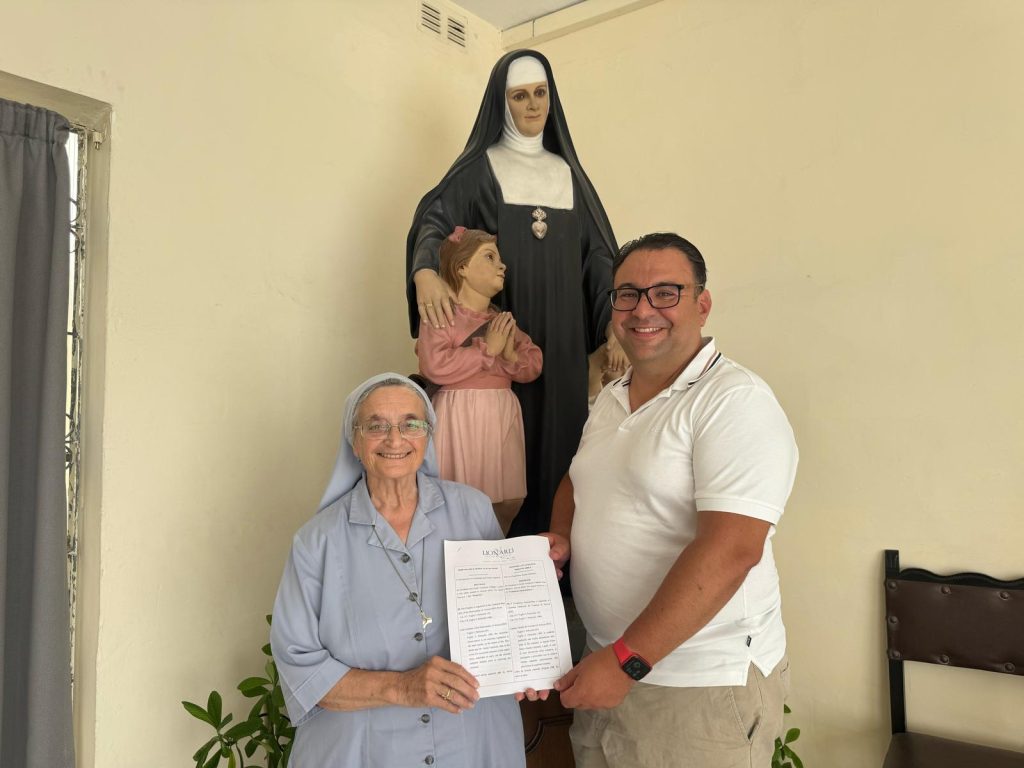
To support this new chapter, Dr Adrian Sciberras of Sciberras Advocates, is assisting Superior General Mother Pawlina Farrugia with legal matters relating to the establishment of the new facility in Italy. His guidance is instrumental in ensuring that the Congregation’s charitable mission can take root and flourish in a new community.

Superior General Mother Pawlina Farrugia and Dr Adrian Sciberras

A Call for Support

The Congregation is also reaching out to the public for support. Any donation, no matter how small, can make a lasting difference in the lives of children and families. The Daughters of the Sacred Heart are deeply grateful for all contributions, which will go directly towards supporting their charitable initiatives both in Malta and abroad.

Donations can be made via cheque, posted to:
Daughters of the Sacred Heart
St Theresa Convent
100, Gorg Borg Olivier Street
Mellieha, MLH 1021

Or by bank transfer to the following account:
APS Bank
Account Name: Daughters of the Sacred Heart
Account No.: 102-35325920014
IBAN: MT10APSB77013000000035325920014

The Daughters of the Sacred Heart remain constant in their mission to spread the love of the Sacred Heart of Jesus, touching lives through education, charity, and compassion. With the continued support of the Maltese community, they hope to carry their message of hope even further.

For media inquiries or to learn more about how to support the Congregation’s work, please contact Superior General Mother Pawlina Farrugia on [email protected] or on 21523532 / 79390715.

Article rédigé par Mme Charlene Sciberras, B.A. (Hons), rédactrice invitée, est une spécialiste du marketing et de la gestion d'entreprise avec un accent particulier sur les questions d'entreprise, comptables et juridiques.

Sciberras Advocates, fondé par Dr Adrian Sciberras, est un cabinet d'avocats basé à Malte. Le cabinet s'enorgueillit d'être multidisciplinaire, innovant et flexible afin de répondre aux évolutions et aux défis du paysage juridique local et international. Quelle que soit la complexité des demandes privées ou d'entreprise, Sciberras Advocates propose des solutions juridiques pratiques et rentables pour atteindre les résultats souhaités. Vous pouvez contacter Sciberras Advocates par téléphone au +35627795222ou par courriel sur [email protected].
Bridging the Labour Gap

Immigration Lawyer

Why Malta Needs Skilled and Unskilled Migrant Workers

Malta’s workforce has undergone a significant transformation over the past decade. Once largely dependent on local talent, the country now heavily relies on Third-Country Nationals (TCNs) to meet its growing economic demands. With Malta’s rapid development and evolving labour market, the need for foreign workers is no longer just an option but a necessity. From highly skilled professionals in the financial and IT sectors to unskilled labourers in construction and hospitality, the role of TCNs is integral to keeping Malta’s industries functional and competitive.

The increasing demand for skilled workers in Malta stems from the expansion of industries that require expertise beyond what the local workforce can supply. Financial services, iGaming, and technology-driven businesses have flourished, creating positions that demand highly specialised knowledge. These industries attract TCNs who bring valuable international experience and innovative skills that contribute to the overall competitiveness of Malta’s economy. Without these foreign professionals, Malta would struggle to maintain its position as a leading financial and technological hub. The presence of skilled TCNs not only helps businesses grow but also encourages knowledge transfer, allowing local employees to develop new competencies and remain competitive in an increasingly globalised job market.

At the same time, the demand for unskilled labour has also surged. Construction, tourism, and care services are sectors that require a steady supply of workers willing to take on physically demanding roles. Many Maltese workers tend to seek employment in more stable or higher-paying sectors, leaving significant gaps that are filled by TCNs. These workers play a crucial role in maintaining the infrastructure that supports Malta’s economic growth, from building new developments to providing essential services in hotels, restaurants, and healthcare institutions. Without their contributions, many businesses would struggle to operate, and the overall quality of services in key industries would decline.

The reliance on foreign labour is also a response to Malta’s shifting demographic trends. An ageing population means that more Maltese citizens are retiring, leading to a decrease in the local workforce. TCNs help balance this shift by providing a steady stream of younger, working-age individuals who contribute to economic stability. Without migrant workers, key industries could suffer from labour shortages that hinder growth and reduce the country’s competitiveness on a global scale.

Cet article est à titre informatif seulement et ne doit pas être interprété comme un avis juridique.

Article written by Dr Adrian Sciberras, FCCA, MIA, CPA, LL.B. (Hons) (Melit.), M. Adv (Melit.), an advocate specialising in immigration and employment law. With a deep commitment to his country, he strives to contribute to discussions on sustainable growth and legal frameworks that support Malta’s future. He can be contacted on [email protected].

Sciberras Advocates, fondé par Dr Adrian Sciberras, est un cabinet d'avocats basé à Malte. Le cabinet s'enorgueillit d'être multidisciplinaire, innovant et flexible afin de répondre aux évolutions et aux défis du paysage juridique local et international. Quelle que soit la complexité des demandes privées ou d'entreprise, Sciberras Advocates propose des solutions juridiques pratiques et rentables pour atteindre les résultats souhaités. Vous pouvez contacter Sciberras Advocates par téléphone au +35627795222ou par courriel sur [email protected].

Notification: Immigration Appeals Board – Decision Day

immigration appeals board Malta

We would like to notify all Third Country Nationals that have an appeal open at the Immigration Appeals Board (IAB) office in Valletta, that after you file your appeal and make submissions, yourself or through your lawyer, you will eventually receive an appointment for the decision of your appeal application.

In this appointment you need to attend personally to collect the decision of your appeal.

It’s important to take your passport with you, and if you have an immigration lawyer, you may consult with them beforehand to assist you accordingly.

If your appeal application is approved, you may continue your stay in Malta in line with the conditions set out in the decision.

If your appeal application is rejected, your passport will be taken by the Immigration Inspector in charge, and you will be given a receipt. You will then be required to leave the Malta within 10 – 15 days. However, you also have the right to file a further appeal before the Court of Appeal. If you wish to file a second appeal, ask an immigration lawyer for assistance.

Kindly note that our team of immigration lawyers in Malta at Sciberras Advocates can assist you with appeals at Immigration Appeals Board and appeals at the Court of Appeal, to protect your immigration status and residency in Malta.

We encourage you to contact us for support on [email protected].

Cet article est à titre informatif seulement et ne doit pas être interprété comme un avis juridique.

Article rédigé par Mme Charlene Sciberras, B.A. (Hons), rédactrice invitée, est une spécialiste du marketing et de la gestion d'entreprise avec un accent particulier sur les questions d'entreprise, comptables et juridiques.

Sciberras Advocates, fondé par Dr Adrian Sciberras, est un cabinet d'avocats basé à Malte. Le cabinet s'enorgueillit d'être multidisciplinaire, innovant et flexible afin de répondre aux évolutions et aux défis du paysage juridique local et international. Quelle que soit la complexité des demandes privées ou d'entreprise, Sciberras Advocates propose des solutions juridiques pratiques et rentables pour atteindre les résultats souhaités. Vous pouvez contacter Sciberras Advocates par téléphone au +35627795222ou par courriel sur [email protected].

Identità: A Year of Reform, Compliance & Customer Focus

Immigration Lawyer

Highlights from Identità’s 2024 Annual Report

The recently published 2024 Annual Report from Identità, Malta’s identity and migration agency, reveals a year of transformation, enhanced compliance, and significant service improvements, all aimed at securing Malta’s identity systems and streamlining immigration services.

Key Developments in Immigration

  • Stronger Screening of Third-Country Nationals (TCNs): Identità introduced two key requirements:
    • Mandatory private health insurance with €100,000 minimum coverage.
    • A Property Attestation Form proving legal residence.
  • Legislative Changes: Enforcement of:
    • The DIER license for temping, recruiting, and outsourcing agencies.
    • The Skills Pass certificate for tourism and hospitality workers.
    • A shift to online processing for employer transfers, ensuring transparency for TCN workers.
  • Improved Compliance: With nearly 500 investigations and 215 field inspections, the Compliance Unit cracked down on overstays, forged documents, and false addresses, referring many cases for legal action.
  • New Immigration Affairs Section: The Expatriates Unit and Central Visa Unit were merged to create a more unified system for residence permits and visa services.
  • Streamlined Visa Processing: Visa processes were overhauled; refusal letters are now more transparent and informative.

For more information on the Expatriates Unit of Identità, please follow this link: https://identita.gov.mt/expatriates-unit-main-page/

What This Means for Immigration Clients

For individuals and businesses navigating Malta’s immigration system, these reforms signal a more transparent, secure, and professional approach. The increased focus on enforcement and due diligence may lead to stricter application scrutiny but also ensures greater fairness and integrity.

At our firm, we’re closely monitoring these developments to help clients stay compliant and make the most of Malta’s evolving immigration framework. Need assistance with a residence or work permit in Malta, or need legal guidance on anything immigration? Get in touch with our expert legal team today.

As a specialised immigration law firm in Malta, we handle numerous procedures for third-country nationals related to work permits, change of employment, family reunification, appeals and more. A digital copy of the Sciberras Advocates’ Identitas Guidelines is available for download here: https://sciberras.legal/wp-content/uploads/2024/08/Identitas-by-Sciberras-Advocates.pdf.

We encourage you to contact us for support on [email protected].

Cet article est à titre informatif seulement et ne doit pas être interprété comme un avis juridique.

Article rédigé par Mme Charlene Sciberras, B.A. (Hons), rédactrice invitée, est une spécialiste du marketing et de la gestion d'entreprise avec un accent particulier sur les questions d'entreprise, comptables et juridiques.

Sciberras Advocates, fondé par Dr Adrian Sciberras, est un cabinet d'avocats basé à Malte. Le cabinet s'enorgueillit d'être multidisciplinaire, innovant et flexible afin de répondre aux évolutions et aux défis du paysage juridique local et international. Quelle que soit la complexité des demandes privées ou d'entreprise, Sciberras Advocates propose des solutions juridiques pratiques et rentables pour atteindre les résultats souhaités. Vous pouvez contacter Sciberras Advocates par téléphone au +35627795222ou par courriel sur [email protected].

Droit du travail : application relative aux dossiers des employés

Employment Lawyer Malta

Rappel de conformité pour les employeurs : obligations de Jobsplus concernant les dossiers des employés

Chez Sciberras Advocates, spécialisés en droit du travail et en droit de l'immigration, nous suivons en permanence les mises à jour qui affectent les obligations de conformité de nos clients. Une communication récente de Jobsplus nous a rappelé opportunément à tous les employeurs l'obligation de soumettre les formulaires d'embauche et de licenciement des employés en vertu de la loi sur les services d'emploi et de formation, chapitre 594 des lois de Malte.

Délais obligatoires pour les formulaires d'engagement et de résiliation

Jobsplus a annoncé l'adoption prochaine d'une politique qui impose un délai strict de quatre jours pour la soumission de :

  • Formulaires d'engagement (Articles 36 et 37, Cap. 594) : Ils doivent être soumis dans les quatre jours suivant la date de début de l'employé.
  • Formulaires de résiliation (Article 40, Chap. 594) : Ils doivent être soumis dans les quatre jours suivant la date de fin d'emploi du salarié.

Le non-respect dans le délai imparti peut entraîner des sanctions administratives conformément à l'article 53 du Cap. 594.

Conséquences supplémentaires dans le cadre de la politique maltaise sur la migration de main-d'œuvre

Outre les pénalités, les employeurs qui soumettent de manière répétée des formulaires d'engagement ou de résiliation en retard peuvent être temporairement disqualifiés du traitement des demandes de permis d'emploi. Ceci est particulièrement pertinent à la lumière de la politique maltaise de migration de la main-d'œuvre, qui lie la conformité administrative à l'accès à la main-d'œuvre migrante.

Compte tenu des implications pour les entreprises employant des ressortissants de pays tiers, la soumission en temps voulu de ces formulaires est essentielle non seulement pour la conformité réglementaire, mais aussi pour assurer la continuité des effectifs.

Actions recommandées pour les employeurs

Jobsplus encourage tous les employeurs à examiner leurs registres d'employés actuels pour s'assurer que la liste des employés actifs est exacte et à jour. Ceci peut être fait en :

  1. Se connecter à votre compte employeur sur le portail Jobplus.
  2. Téléchargement de votre liste d'employés actifs actuelle.
  3. Vérification de l'exactitude de vos dossiers et traitement des incohérences.

Soumission de formulaires en ligne

Tous les formulaires d'embauche doivent être soumis en ligne, sauf dans les cas suivants :

  • Travailleurs indépendants (sans employés)
  • Employeurs particuliers

Ces deux catégories peuvent continuer à soumettre leurs formulaires par e-mail. Pour toutes les autres, l'accès au portail Jobsplus est requis, et les utilisateurs doivent être autorisés à gérer le profil de l'entreprise. Des instructions sur la manière d'obtenir l'accès au portail sont également disponibles via Jobsplus.

Besoin d'aide pour la conformité ?

Chez Sciberras Advocates, nous accompagnons les employeurs dans tous les aspects de la conformité en droit du travail, de la préparation et de la révision des contrats à la gestion des déclarations réglementaires et à la représentation des clients devant des autorités telles que Jobsplus et Identita’.

Si vous avez besoin d'aide ou de conseils sur vos obligations en vertu du droit du travail maltais, contactez notre équipe dès aujourd'hui au [email protected].

Cet article est à titre informatif seulement et ne doit pas être interprété comme un avis juridique.

Article rédigé par Mme Charlene Sciberras, B.A. (Hons), rédactrice invitée, est une spécialiste du marketing et de la gestion d'entreprise avec un accent particulier sur les questions d'entreprise, comptables et juridiques.

Sciberras Advocates, fondé par Dr Adrian Sciberras, est un cabinet d'avocats basé à Malte. Le cabinet s'enorgueillit d'être multidisciplinaire, innovant et flexible afin de répondre aux évolutions et aux défis du paysage juridique local et international. Quelle que soit la complexité des demandes privées ou d'entreprise, Sciberras Advocates propose des solutions juridiques pratiques et rentables pour atteindre les résultats souhaités. Vous pouvez contacter Sciberras Advocates par téléphone au +35627795222ou par courriel sur [email protected].

Notification: Summer Hours – Immigration Appeals Board (IAB) office

Immigration Appeals Board Malta

We would like to notify all Third Country Nationals that the Immigration Appeals Board (IAB) office in Valletta is on summer hours as of this week.

The opening hours from 16th June to 30th September are as follows:

Monday, Tuesday, Thursday, Friday – open from 8am to 12pm

Wednesday – closed all day

The office is closed during weekends and public holidays.

The public is not accepted outside of the opening hours listed above.

Also, very important is that it is mandatory to provide an Original Identification Document to lodge appeals, such as Residence Card or Passport.

Kindly note that our team of immigration lawyers in Malta at Sciberras Advocates can assist you with work permit appeals to protect your immigration status and residency in Malta.

We encourage you to contact us for support on [email protected].

Cet article est à titre informatif seulement et ne doit pas être interprété comme un avis juridique.

Article rédigé par Mme Charlene Sciberras, B.A. (Hons), rédactrice invitée, est une spécialiste du marketing et de la gestion d'entreprise avec un accent particulier sur les questions d'entreprise, comptables et juridiques.

Sciberras Advocates, fondé par Dr Adrian Sciberras, est un cabinet d'avocats basé à Malte. Le cabinet s'enorgueillit d'être multidisciplinaire, innovant et flexible afin de répondre aux évolutions et aux défis du paysage juridique local et international. Quelle que soit la complexité des demandes privées ou d'entreprise, Sciberras Advocates propose des solutions juridiques pratiques et rentables pour atteindre les résultats souhaités. Vous pouvez contacter Sciberras Advocates par téléphone au +35627795222ou par courriel sur [email protected].